
On the common sort of tester, yes. Almost every one of them will read moissanite as diamond, and the reason is worth understanding, because it explains something true about the stone rather than something clever about the test.
What the tester is actually measuring
A handheld diamond tester does not look at a stone. It touches it with a heated probe and measures how quickly that heat travels away. Diamond carries heat extraordinarily well, better than almost any material on earth, and for decades that was a reliable way to separate it from glass, cubic zirconia and paste.
Moissanite is silicon carbide. It happens to carry heat almost as well as diamond does. So the probe warms it, the heat runs away at a diamond-like rate, and the light turns green.
How a modern tester tells them apart
Testers sold today usually carry a second probe for electrical conductivity. Moissanite conducts electricity; diamond, in almost every case, does not. A dual tester reads the heat, reads the current, and names moissanite correctly.
A jeweller with a loupe has an older method. Moissanite is doubly refractive, meaning it splits light into two paths, so looking down through the table at the far facet edges you can see them doubled. Diamond is singly refractive and shows single edges. It is the oldest and still the surest way to tell by eye.
What this means if you are wearing it
Very little, and that is rather the point. The reason moissanite reads as diamond on a thermal tester is the same reason it wears like one: it is a genuinely hard, genuinely dense, genuinely brilliant stone, and 9.25 on the Mohs scale places it among the hardest set into jewellery.
It is also the reason it returns so much light. Moissanite has a higher refractive index than diamond and more than twice its dispersion, which is why a small stone throws so much colour in ordinary daylight.
What this house says about it
Clariva sells moissanite and calls it moissanite. Every piece arrives with a card naming the stone it holds, so if you are ever asked, the answer is already in your keeping. It is a real gemstone, grown in a laboratory rather than drawn from the ground, and it is beautiful on its own terms.
The piece this was written beside

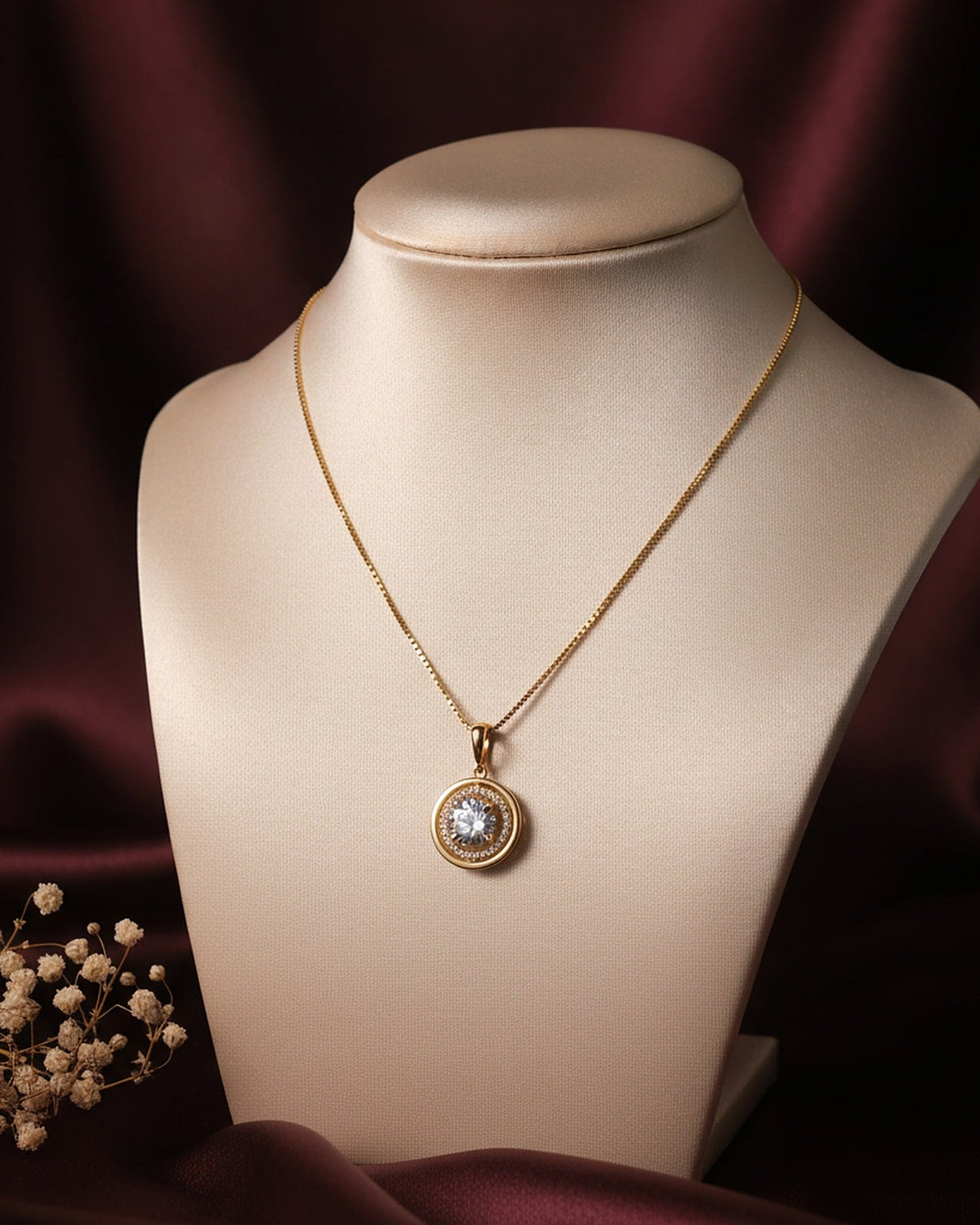
The Aurelia Pendant Necklace, $116.99. Moissanite set in 925 sterling silver beneath a waterproof, tarnish resistant gold tone, on its chain, with tracked delivery included.