
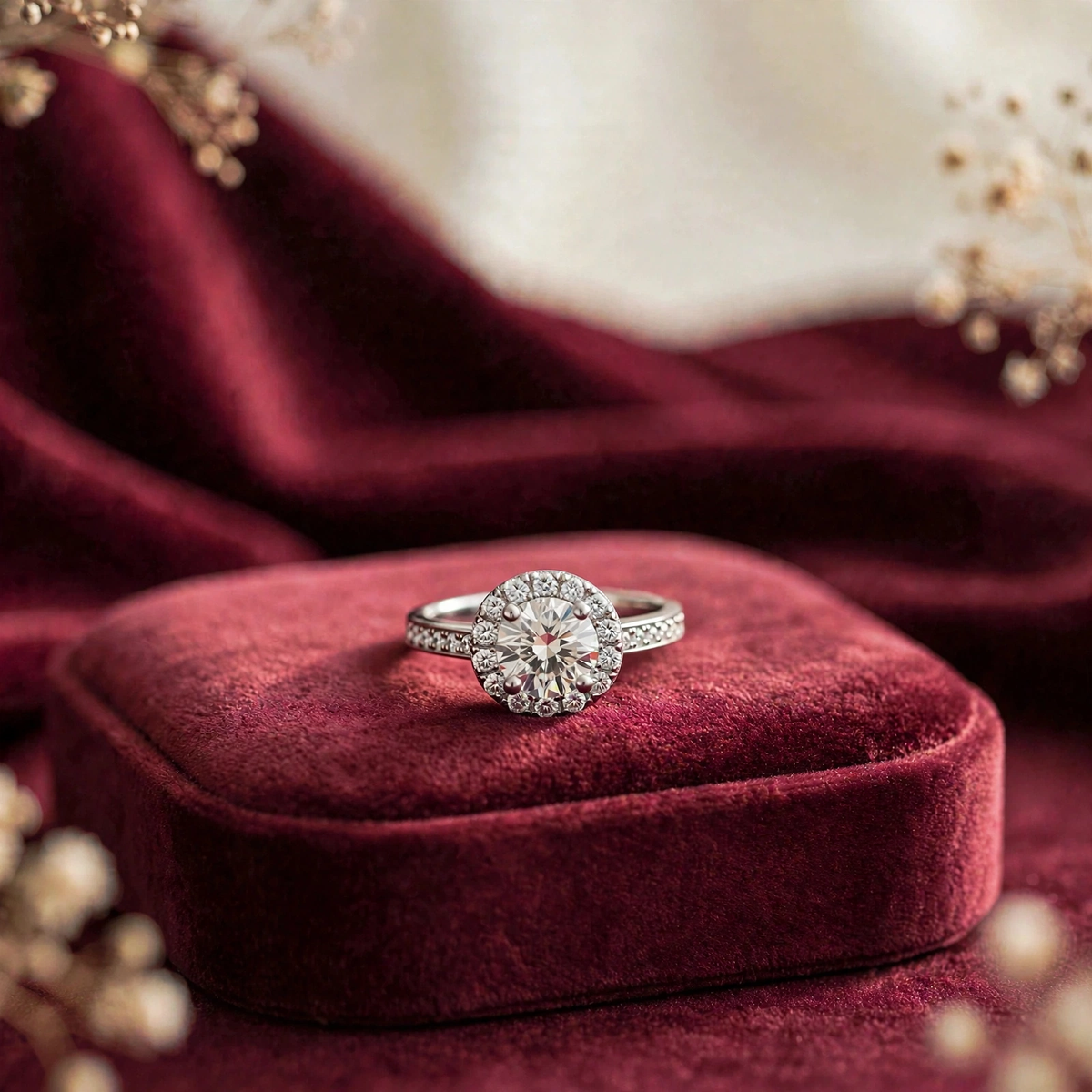
Moissanite and diamond look alike across a room and quite different close up. These are the tests in order of how easy they are, and what each one actually proves.
1. Look at the fire, in daylight
This is the test you can do without owning anything.
Dispersion is the splitting of white light into colour, the flashes of red, blue and green that jewellers call fire. Moissanite measures 0.104 on that scale. Diamond measures 0.044. Moissanite throws roughly two and a half times as much.
Take the stone into daylight and tilt it slowly. A diamond flashes mostly white with colour appearing here and there. A moissanite throws rainbow colour continually, and in a larger stone it is obvious. Jewellers sometimes call it the disco effect.
It is not proof on its own, because a well cut moissanite in dim indoor light can look restrained. But in daylight, on anything above about six millimetres, it is usually the first thing you notice.
2. Look for doubled edges, with a loupe
This is the proper test, and it is conclusive.
Moissanite is doubly refractive: it splits light entering it into two paths. Diamond is singly refractive and does not.
Look down through the flat top facet with a ten times loupe, focusing on the facet edges at the far side of the stone. In moissanite those far edges appear doubled, like a line drawn twice slightly out of register. In diamond they are single and crisp.
Look through the top, not the side, and look at the back edges rather than the near ones. This test is over a century old and it still has not stopped working. It is why a competent jeweller identifies moissanite in seconds.
3. The diamond tester, and why it fails
The common handheld tester does not look at the stone at all. It touches it with a warmed probe and measures how fast the heat conducts away. Diamond carries heat better than almost any material on earth, and for decades that reliably separated it from glass and cubic zirconia.
Silicon carbide happens to conduct heat almost as well. The probe warms the stone, the heat leaves at a diamond-like rate, and the tester reports diamond.
So a basic thermal tester saying diamond proves very little. Testers sold today usually add a second probe for electrical conductivity: moissanite conducts electricity and diamond, in almost every case, does not. A dual tester names moissanite correctly. If you are relying on a tester, make sure it is a dual one.
4. Weight, if you can measure it
Moissanite has a specific gravity of about 3.22. Diamond is 3.52. Moissanite is roughly ten percent lighter for the same volume.
In practice this means a moissanite cut to the same millimetre size as a one carat diamond weighs about 0.88 carats. If you have a loose stone, a scale and a millimetre gauge, the mismatch between size and weight gives it away.
Set stones cannot be weighed, so this one is mostly for loose material.
Tests that do not work
The fog test. Breathe on the stone and see how fast the condensation clears. Both stones conduct heat well enough to clear quickly, and room conditions affect it more than the material does.
The scratch test. At 9.25 and 10 on the Mohs scale, both will scratch glass and steel without difficulty. All you learn is that it is not cubic zirconia, and you risk damaging the setting.
The newspaper test. Reading print through a stone tells you about cut quality, not material.
What this means when you are buying
Moissanite is straightforward to identify. A loupe settles it and a dual tester settles it. That matters because of what it implies about how a seller talks to you.
Any listing suggesting a stone is undetectable, or that it will pass as a diamond, is either mistaken or hoping you will not check. A competent jeweller will spot it immediately, and a valuation will name it correctly.
The better sellers simply say what the stone is. We sell moissanite necklaces and pendants and we call the stone moissanite everywhere it appears. It passes a thermal diamond tester, and this house still calls it moissanite.